Business Alignment
Business objectives, use cases, expected outcomes, decision points, and the suitability of AI for the work being considered.

AI capabilities in policy, billing, and claims platforms create new opportunities. But successful adoption depends on more than the technology. Insurers need to understand whether their data, processes, governance, architecture, and people are prepared to support AI in production.
Insurance platforms increasingly offer AI-enabled capabilities. Yet an insurer may still have fragmented data, inconsistent business definitions, undocumented processes, unclear decision ownership, or controls that were not designed for AI-supported decisions.
Without understanding these dependencies, organizations risk automating flawed processes, relying on incomplete or inaccurate information, and introducing decisions that are difficult to explain, validate, or oversee.
AIA's assessment is designed to help insurance leaders understand their current readiness, identify gaps, and establish a practical path forward before expanding AI use.
The assessment looks beyond the AI feature itself to the business and technology conditions that determine whether it can be used reliably.
Business objectives, use cases, expected outcomes, decision points, and the suitability of AI for the work being considered.
Data availability, completeness, quality, lineage, ownership, timeliness, and fitness for the intended AI use.
Core platforms, integrations, data flows, architecture, access, and the technology dependencies supporting AI.
Accountability, oversight, validation, monitoring, documentation, privacy, security, and escalation procedures.
Workflow design, handoffs, exception handling, human review, operational controls, and process impacts.
Roles, skills, training, adoption, change readiness, and the ability to understand and challenge AI-supported results.
AIA evaluates the business and technology capabilities that influence whether AI can be introduced and used responsibly in insurance operations.
The assessment brings the findings together in a clear view of readiness, gaps, risks, recommendations, and the next steps management should consider.
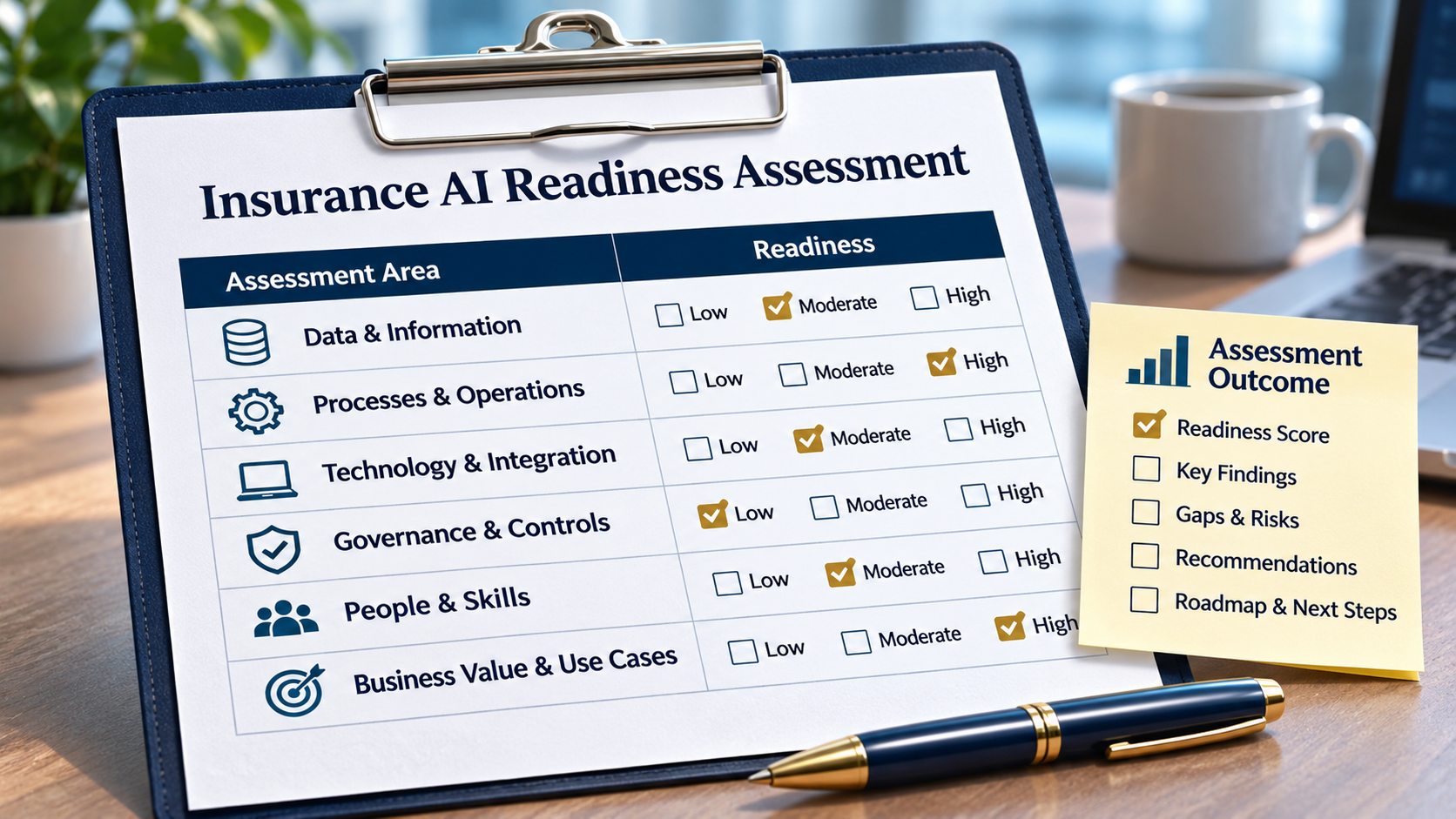
A structured engagement that moves from understanding the business objective to a prioritized, actionable roadmap.
Clarify the AI opportunity, business objectives, stakeholders, and intended decisions or workflows.
Review relevant data, platforms, architecture, processes, governance, controls, and organizational capabilities.
Determine where weaknesses, dependencies, risks, or missing capabilities could affect implementation.
Evaluate gaps by business impact, risk, urgency, dependencies, and practical feasibility.
Present findings, recommendations, priorities, and a practical path toward responsible adoption.
AIA brings practical insurance, operational, data, and technology experience to the assessment. We understand that AI readiness is not solely an IT issue: it affects underwriting, claims, policy administration, customer service, compliance, and the people accountable for business outcomes.
Our role is to help leadership see the whole picture, ask the right questions, and make informed decisions about where and how to proceed.
Discuss your AI plans, current platform capabilities, and the readiness questions your organization needs to answer.
Schedule an AI Readiness Discussion →